
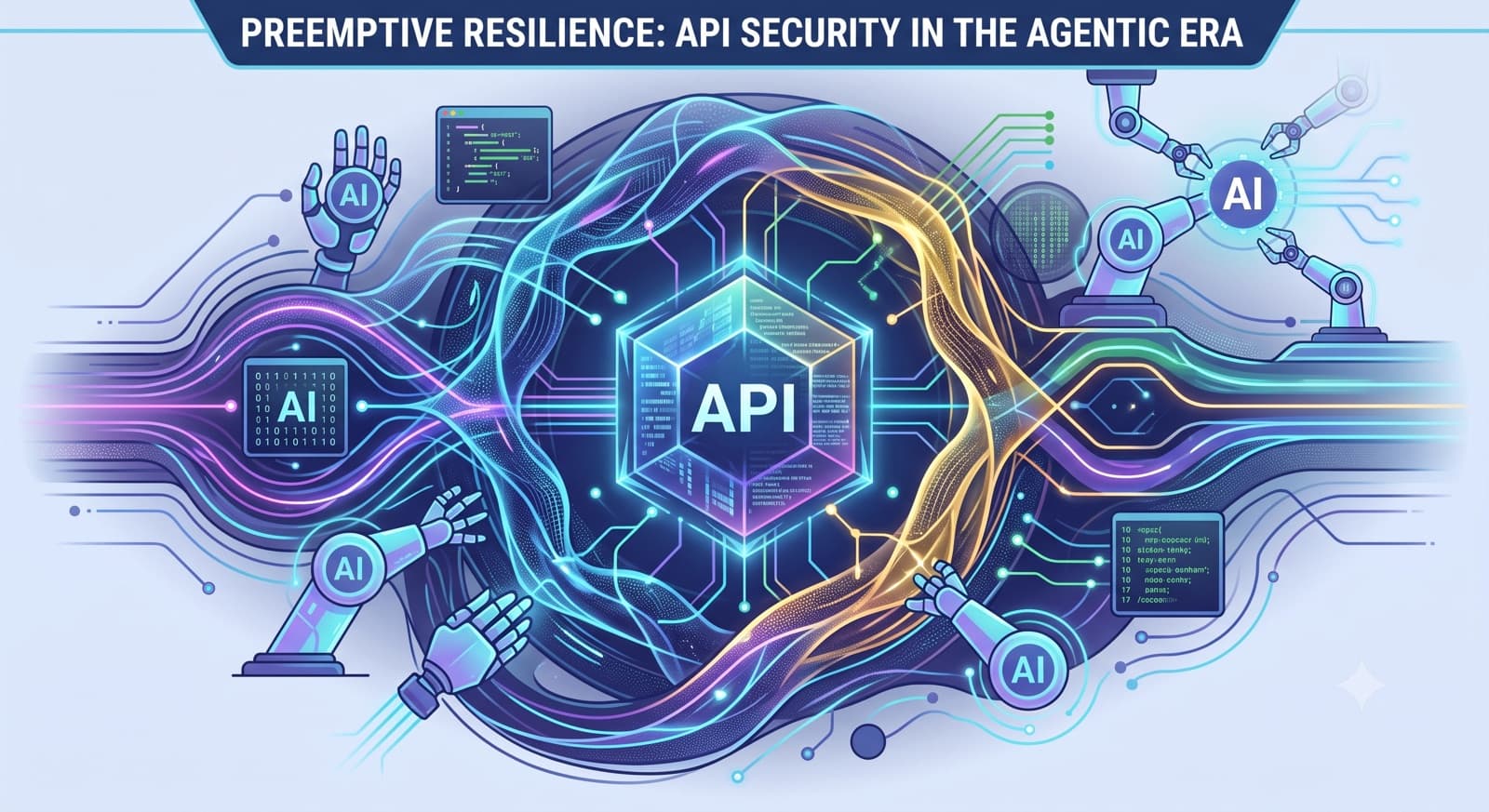
For years, incident response sat at the center of API security strategy: detect fast, contain fast, learn from the postmortem. That worked when traffic was mostly human and predictable.
The agentic era changes that equation. AI agents call endpoints in sequence, compose calls in ways no product team planned for, and operate 24 hours a day, without the natural pauses that used to leave room for a manual response. When the consumer of your API is another autonomous system, the gap between "something went wrong" and "something went very wrong" can be a matter of seconds.
What changes in practice
Preemptive resilience isn't about having a prettier observability dashboard. It's about inverting the question: instead of "how fast can we react?", ask "how do we know, before the first autonomous agent touches this endpoint, which paths can break?".
That requires three shifts in posture:
- Map the real surface, not the documented one. API specs describe what should happen. Agents explore what can happen — including parameter combinations and call sequences that never showed up in a manual test.
- Prioritize by business context, not just CVSS. A "medium" severity vulnerability on an endpoint that processes financial settlement outweighs a "high" on a low-impact endpoint. Context changes priority.
- Treat remediation as part of the cycle, not next quarter's problem. Finding the risk without closing the remediation loop is, in practice, just a new backlog item.
That assessment has to keep up with changes to the system. See which behaviors to reassess when an API changes (in Portuguese).
If the only metric your team tracks is mean time to respond to incidents, you're optimizing for the wrong problem in the agentic era.
Where to start
You don't need to rewrite your entire security strategy at once. The usual starting point is a single critical surface — the set of endpoints that, if compromised, would create the largest financial, regulatory, or reputational impact. From there, the assessment model (point-in-time, continuous, or self-hosted) adjusts to whatever pace makes sense for your context.
The goal isn't to eliminate all risk before every release — that was never realistic. It's to shrink the distance between "a risk exists" and "someone on your team knows about it," so the decision to act is yours, not the next incident's.