
Before putting an application built with vibe coding into production, you need to assess authentication, permissions, data isolation and the protection of sensitive operations. The assessment should investigate attempts to bypass these restrictions and produce evidence of what the application actually allows.
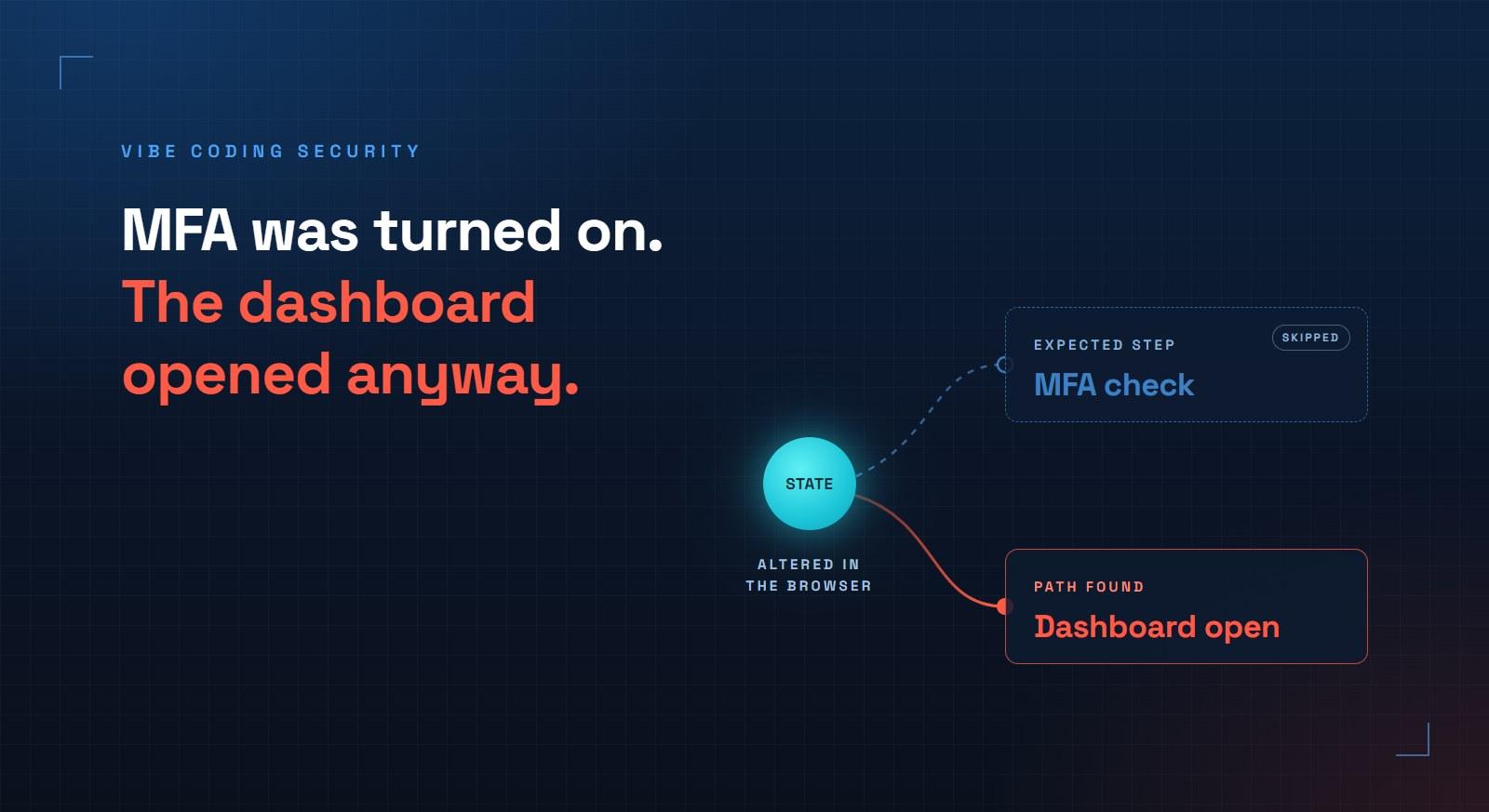
A case assessed by R/Pulse shows why this matters. A sales app had multi-factor authentication (MFA). During the investigation, our security agent managed to bypass that step and access the sales dashboard.
For technology and security leaders, the finding helps frame a release criterion: which controls were put to the test, and what did the results show?
What is vibe coding, and how does it change security assessment?
Vibe coding is a way of building software by describing what you want in natural language and handing a significant part of the implementation to AI. The tool writes the code, and the person steers the adjustments based on the results.
This process gets you to a usable application quickly. Responsibility for assessing the software stays with the organization, especially once it starts accessing customer information, integrating systems or running important operations.
The Canadian Centre for Cyber Security recommends scaling up review, testing and approval as the risk of AI-built software grows. A tool with dummy data and a system that moves financial information call for care in proportion to their consequences.
The practical question is recognizing when the project stopped being a demo and started carrying business risk.
The R/Pulse case: an MFA step that could be bypassed
In the application assessed, the decision to treat MFA as complete depended on data stored in the user's browser. By manipulating that state, the agent got past the verification and accessed the dashboard.
Bruno Abreu, co-founder and CTO of Sofist, described the assessment in News Sofist (in Portuguese). The case was also covered in a Crypto ID article on security in AI-built applications (in Portuguese).
The problem involved a trust boundary: information the user could change themselves influenced a security decision. The investigation demonstrated a way past a step that was supposed to restrict access.
That is the case's main lesson for other organizations. When you assess an application, you have to check whether its restrictions still hold when someone tries to bypass them.
Why doesn't the interface prove the application is protected?
The interface presents the expected path through the system. A security assessment also considers access and actions outside that path.
Take a hypothetical example: a profile without permission to export data doesn't see the export button. To show the restriction works, you need to check that this profile is also blocked from requesting the export directly from the service responsible for it.
OWASP advises verifying access control decisions in a trusted layer, such as the server. Checks in the browser can support the user experience, but they shouldn't decide on their own who gets access.
That's why functional approval and security assessment answer different, complementary questions. One shows the task can be done; the other investigates under what conditions it can be done improperly.
What should you check before putting an AI-built application into production?
Scope should start from the data, access and operations the application brings together. The table below suggests questions to guide the assessment; the examples are hypothetical.
| Area | Question for the assessment | Useful evidence for the decision |
|---|---|---|
| Authentication | Can a required step be skipped or bypassed? | Result of trying to access a restricted resource without completing verification. |
| Permissions | Can one profile perform an action reserved for another? | Operation attempted, profile used and the application's response. |
| Data isolation | Can one account access information that belongs to another? | Record of which data became accessible or was correctly blocked. |
| Sensitive operations | Is an approval or restriction still enforced outside the interface flow? | Result of trying to perform the operation through another path. |
For leadership, a list of problems is more useful when it explains what was demonstrated. The record of a finding should make clear the affected operation, the assessment conditions, the observed consequence and the fix required.
The results help the team decide which fixes are needed before release and which points still need investigation. After remediation, reassessment checks whether the behavior found has been corrected.
Is asking the AI to review its own code enough?
AI self-review can support development, but it needs to be combined with other controls. The Canadian Centre for Cyber Security warns that a single model reviewing its own work is a weak control when used on its own.
The organization should combine technical review, testing and security investigation according to how critical the application is. The depth of the assessment depends on the access granted, the data involved and the consequences of a failure.
How do you keep track of security after launch?
The assessment needs to keep up with relevant changes in the product. An integration can widen the data that's accessible; a profile change can alter permissions; a login revision can affect authentication.
These events help define when to reassess and which operations should be in scope. For applications that depend on APIs, this work also involves reassessing business rules after changes.
How does AASA support the assessment of these applications?
R/Pulse AASA is the R/Pulse agentic pentesting module. It expands the security team's capacity to investigate applications, including AI-built ones, within the scope and limits the organization defines.
During the assessment, the agent adjusts the investigation to what it finds. The risks identified come with evidence to support analysis and prioritization. After remediation, a new assessment checks the behavior related to the finding.
In the MFA case, an attempt to bypass the step revealed that the restriction could be overcome. Applying this kind of investigation to the applications heading into production helps decide what needs fixing before improper access happens outside an authorized assessment.